
Syllable Division Rules
Have you ever noticed that children can read short words like cat, dog, and sun easily but struggle when they come across longer words like fantastic, remember, or important? This is quite common among young readers. Long words may look difficult at first, but they become much easier to read when children learn to break them into smaller parts.
Instead of trying to read the entire word at once, children can divide it into smaller chunks called syllables. This helps them recognise familiar sounds, read unfamiliar words, and improve their reading fluency.
For example:
Fantastic – fan / tas / tic
Remember – re / mem / ber
Rabbit – rab / bit
- Sunset – sun / set
Once children understand how to break words into syllables, reading longer words becomes less confusing. It also supports spelling and pronunciation.
What Is a Syllable?
A syllable is a word or a part of a word that contains one vowel sound. Every syllable has a vowel sound, and a word can have one or more syllables.
For example:
Cat – 1 syllable
Tiger – 2 syllables (ti / ger)
Banana – 3 syllables (ba / nan / a)
Alligator – 4 syllables (al / li / ga / tor)
Remember, we count vowel sounds, not vowel letters. For example, the word team has two vowel letters, but they work together to make one vowel sound. Therefore, team has only one syllable.
Six Types of Syllables
There are six commonly taught syllable types in phonics: Closed, Open, Vowel-Consonant-e (VCe), Vowel Team, R-Controlled, and Consonant-le.
What Are Syllable Division Rules?
Syllable division rules help children understand where to break longer words into smaller parts. By looking at the vowels and consonants in a word, children can identify common patterns and use them to read unfamiliar words.
Let’s look at the important syllable division rules with examples.

Practice bigger words using syllable division rules. Use our poster as you see in the example shown below. Get free Download link at the end of the explanation.
1. VC/CV Rule (Vowel-Consonant / Consonant-Vowel)
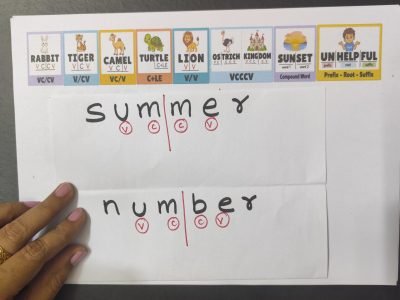
When two consonants come between two vowels, we usually divide the word between the consonants. This gives us two syllables, and the vowels generally make their short sounds.
Examples:
Rabbit – rab / bit
Napkin – nap / kin
Sunset – sun / set
Picnic – pic / nic
Kitten – kit / ten
Magnet – mag / net
Remember: When two consonants come between two vowels, try dividing between the consonants.
2. V/CV Rule (Vowel/ Consonant-Vowel)
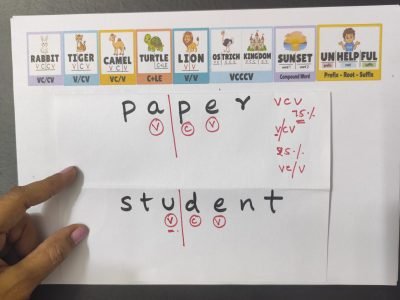
When one consonant comes between two vowels, try dividing the word before the consonant. This makes the first syllable open, so the vowel usually makes its long sound.
Examples:
Tiger – ti / ger
Music – mu / sic
Paper – pa / per
Robot – ro / bot
Silent – si / lent
Remember: Try dividing before the consonant first. If the word sounds right, you have found the correct division.
3. VC/V Rule (Vowel-Consonant / Vowel)
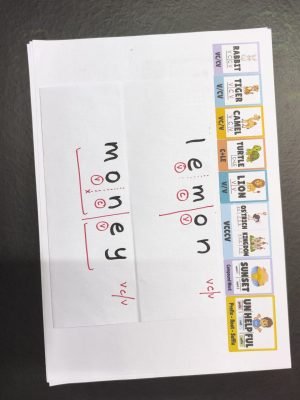
Sometimes dividing before the consonant does not give us the correct pronunciation. In such cases, try dividing after the consonant. The first syllable becomes closed, and its vowel usually makes a short sound.
Examples:
Cabin – cab / in
Lemon – lem / on
Seven – sev / en
Visit – vis / it
Finish – fin / ish
Remember: If the V/CV pattern does not produce the correct pronunciation, try the VC/V pattern.
4. V/V Rule (Vowel / Vowel)
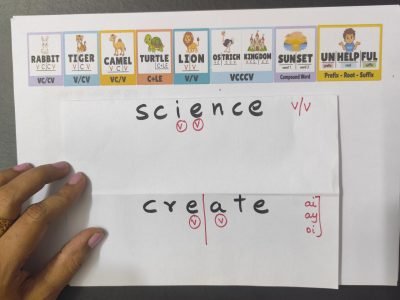
When two vowel have their individual sound, divide between the vowel sounds. This often happens when the vowels do not work together as a vowel team.
Examples:
Lion – li / on
Quiet – qui / et
Poem – po / em
Diet – di / et
Ruin – ru / in
Remember: Listen carefully to the vowel sounds. If they make two separate sounds, they may belong to different syllables.
5. Consonant-le Rule
When a word ends with a consonant followed by -le, divide the word before the consonant-le ending. Keep the consonant and -le together because they form the final syllable.
Examples:
Table – ta / ble
Candle – can / dle
Little – lit / tle
Purple – pur / ple
Apple – ap / ple
Bubble – bub / ble
Remember: The consonant and -le always stay together in the final syllable.
6. VCCCV (Keep Consonant Blends and Digraphs Together)
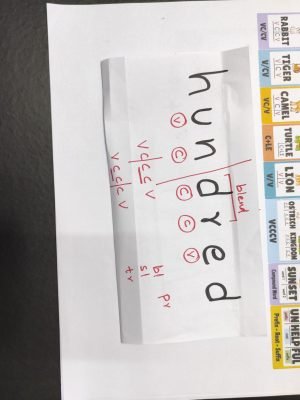
When three consonants come between two vowels, we usually divide the word after the first consonant. However, we need to check whether the consonants form a blend or digraph before deciding where to divide.
Examples:
Contract – con / tract
- Pumpkin – pump / kin
Pilgrim – pil / grim
Confident – con / fi / dent
Hundreds – hun / dreds
Remember: When three consonants come between two vowels, try dividing after the first consonant. Keep consonant blends and digraphs together whenever they begin the next syllable.
Note: The VCCCV pattern does not always mean dividing after the first consonant. For example, kingdom is divided as king / dom because the consonant blend tr stays together.
7. Compound Word Division
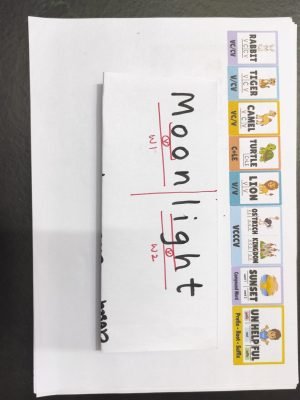
Compound words are made by joining two smaller words to form a new word. These words are usually easy to divide because we can identify the original words.
Examples:
Sunflower – sun / flower
Football – foot / ball
Raincoat – rain / coat
Bedroom – bed / room
Toothbrush – tooth / brush
Playground – play / ground
Cupcake – cup / cake
Remember: Look for the two smaller words that make up the compound word and divide where they join.
8. Prefix, Root Word and Suffix Division
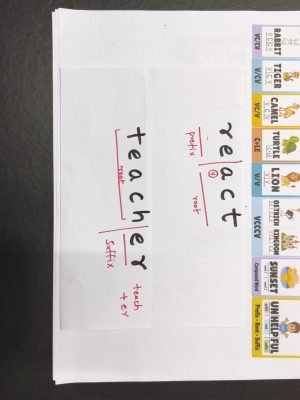
Many longer words are formed by adding prefixes and suffixes to a root word or base word. Recognising these word parts makes it easier for children to understand how words are formed and what they mean.
A prefix is added to the beginning of a word, while a suffix is added to the end. The root word carries the main meaning.
Examples:
Un + happy = unhappy
Re + play = replay
Dis + agree = disagree
Help + ful = helpful
Care + less = careless
Teach + er = teacher
When we look at the parts of these words, we can identify:Unhappy – un / hap / py
Replay – re / play
Disagree – dis / a / gree
Helpful – help / ful
Teacher – teach / er
Quickly – quick / ly
Unhelpful – un / help / ful
Remember: Prefixes, root words, and suffixes help children recognise meaningful parts of words.
How to Help Children Practise Syllable Division
Learning the rules is only the first step. Children need regular practice to become comfortable dividing longer words. Here are a few simple activities you can try at home or in the classroom:
Clap the syllables: Say a word aloud and ask children to clap once for every syllable they hear.
Mark the vowels: Encourage children to identify the vowel sounds before dividing a word.
Use colour coding: Highlight vowels and consonants in different colours to make word patterns easier to understand.
Build words: Use letter cards to form longer words and ask children to divide them into syllables.
Read and blend: Let children read each syllable separately and then blend the parts to read the complete word.
Practise with word lists: Begin with simple two-syllable words and gradually introduce longer words.
Final Thoughts
Long words do not have to be difficult for children to read. Once they understand how to identify syllables and use common division patterns, they can approach unfamiliar words with much more confidence.